We often hear from property owners in Petaling Jaya that concrete leaks feel impossible to stop once they start. This frustration usually peaks during the monsoon season when standard surface sealants wash away.
Our team has found that understanding the root cause is the dividing line between temporary patches and permanent fixes.
For comprehensive waterproofing and leak repair, PU injection grouting is one of the most effective methods for concrete slab and wall cracks.
We are going to break down the mechanics of this treatment and walk through the exact steps to protect your property.
What PU grouting actually is
Polyurethane (PU) injection grouting is a structural repair method that pumps expanding resin directly into leaking concrete cracks to seal them from the inside. Our team uses a two-part polyurethane resin that reacts with moisture to expand and form a watertight seal.
This specific treatment works incredibly well for residential and commercial concrete slabs. We frequently use premium hydrophobic grouts like Pentens PU-300 because they actively push water out of the cavity. The chemical reaction expands the resin up to ten times its original volume.
Here is a quick comparison of standard crack repair materials:
| Material | Expansion Rate | Flexibility | Best Use Case |
|---|---|---|---|
| Polyurethane (PU) | 5x to 10x | High | Active leaks, moving cracks |
| Epoxy Resin | None | Low | Structural binding, dry cracks |
| Hydraulic Cement | Minimal | Zero | Surface patching, large dry voids |
How the injection process works
The concrete crack injection process systematically forces liquid polyurethane into a prepared concrete crack using high-pressure mechanical equipment. This method ensures the resin reaches the entire depth of the slab before it expands and hardens.
Our technicians follow a precise sequence to guarantee a permanent seal.
Crack preparation. The crack is cleaned of debris and any loose material. We sometimes apply a surface seal along the crack using an epoxy paste to keep the injected resin from escaping outward.
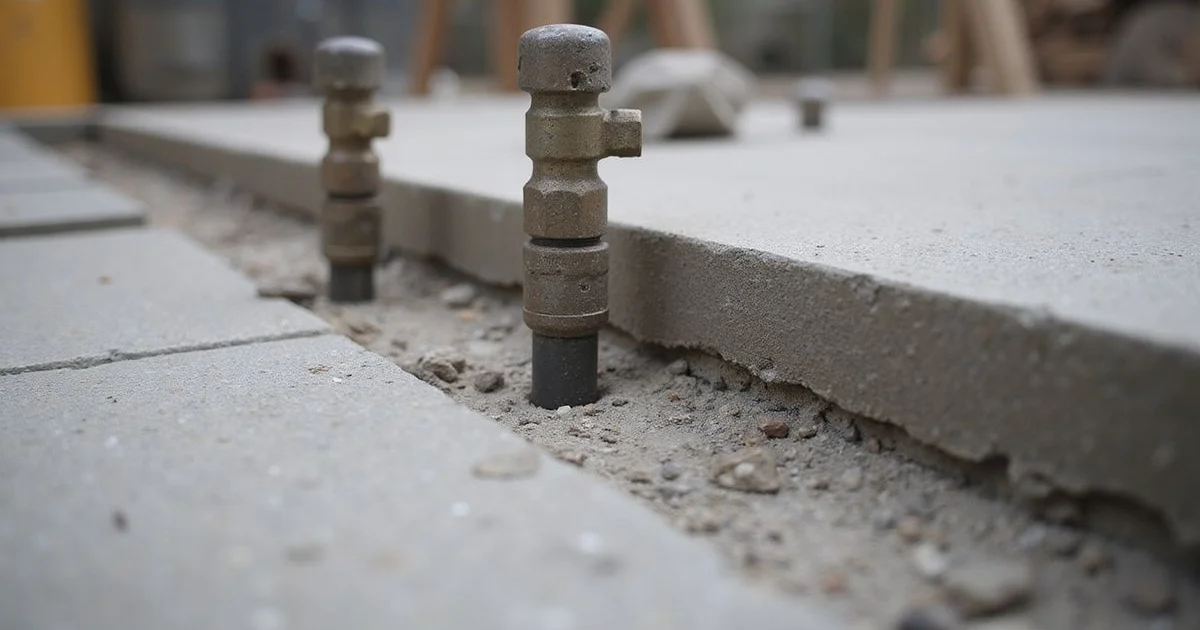
Injection ports installed. Small mechanical ports called packers are drilled directly into the crack at regular 45-degree angles. Our crews space these packers based on the thickness of the wall to give the resin a controlled entry point.
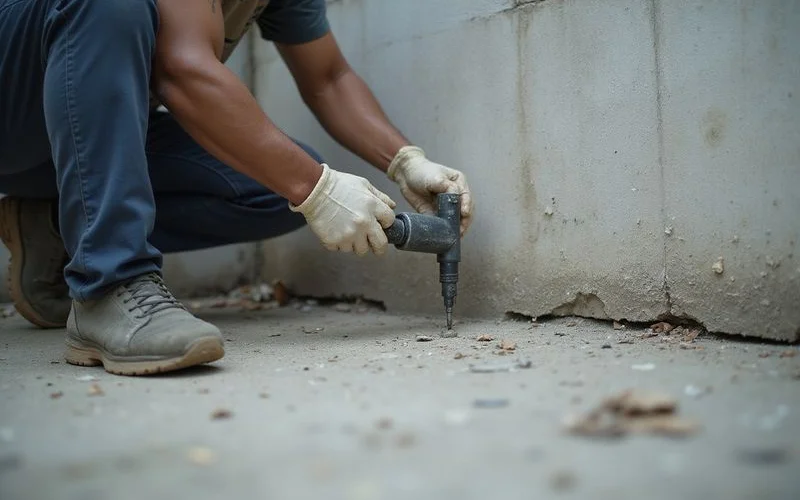
Resin injected under pressure. The PU resin is pumped into the lowest port using specialised equipment that can reach pressures between 1,500 and 3,000 psi. We continue pumping until the liquid appears at the next port up, sealing the lower port to force the material upward. This high-pressure technique ensures the resin fills the crack completely from bottom to top.
Resin expands and cures. The polyurethane expands rapidly as it reacts with the moisture inside the wall. Our clients are always amazed to see it pressing into every crevice to form a flexible seal that handles small future ground movement.
Ports removed, surface finished. Once fully cured, the injection ports are removed. We then patch and finish any surface evidence so the wall looks completely normal again.
Where PU grouting works best
PU grouting works best for active, leaking cracks in structurally sound concrete where water is currently flowing. This method is highly effective for basements, concrete roof slabs, and balconies that suffer from seasonal water intrusion.
Our experience in areas like Saujana Damansara and Petaling Jaya shows that soil settlement is a major factor in these leaks. The weathered granitic soil in the Klang Valley frequently shifts, causing rigid concrete to fracture. We recommend PU injection for these specific scenarios because the cured resin remains flexible enough to survive slight soil movements.
PU grouting suits situations where:
- The leak is through a defined crack that is visible or detectable.
- Our inspection confirms the crack penetrates the entire slab thickness.
- Active water flow through the crack provides moisture to trigger the chemical expansion.
- We determine the structural concrete is otherwise strong and sound.
- The root cause of the crack is understood and relatively stable.
Concrete roof slab cracks letting water through during heavy rain are a textbook case. We also see great results on bathroom floor cracks that drip into the room below or basement wall cracks letting groundwater inside.
Where PU grouting isn’t the right approach
PU grouting solves specific kinds of leaks and cannot fix widespread structural failure or surface membrane degradation. It is exclusively designed for targeted crack repair rather than general waterproofing coverage.
Our team always performs a thorough assessment because diagnosing the actual cause matters as much as picking the repair method. You can learn more about identifying these structural issues in our why concrete ceilings leak guide. We will decline to use PU injection in situations where a different strategy is required.
Here are three common scenarios where a different approach is necessary:
- Membrane failure (no crack): A flat roof leaking because the waterproof PU acrylic membrane has failed needs a full membrane replacement.
- Plumbing leak from above: A broken PVC pipe imitating a roof leak requires a plumber to fix the water line.
- Severely deteriorated concrete: Grouting one single crack does nothing if the entire slab is failing from severe concrete spalling or structural weakness.
What to expect during the work
A typical residential PU injection job is a fast, targeted process that is usually completed within a single day. The work involves minimal disruption, creating far less noise and dust than traditional hacking and rebuilding methods.
Our standard project flow is highly organised to respect your time and property. Based on 2026 industry pricing data, property owners across the Klang Valley typically pay between RM800 and RM2,500 for localised single-spot crack repairs. We follow a strict timeline to ensure the area is protected and the leak is sealed efficiently.
For a typical residential PU injection job, here is the rhythm:
Day 1, morning: Site setup and crack preparation happen first. We tape off the area, clean the crack, and drill the necessary holes to install injection ports along its length.
Day 1, afternoon: Injection begins once the packers are secure. Our technicians systematically pump the resin under high pressure, and the curing process starts immediately upon contact with moisture.
Day 1, end or Day 2: Finishing touches conclude the project. We remove the ports after the resin has fully hardened and patch the concrete surface so it looks pristine.
The total time depends on the crack length, the number of ports needed, and access difficulty. Most single-room ceiling jobs finish in just a few hours.
Durability of the repair
A properly executed PU grouting repair is exceptionally durable and will typically last for the remaining lifespan of the concrete structure. The injected polyurethane resin is chemically stable and does not degrade under normal environmental conditions.
Our clients often worry about future movement tearing the repair open again. The cured resin remains incredibly flexible, allowing it to expand and contract with the small thermal shifts common in the Malaysian climate. We see very few failures of the actual grout material itself.
Why secondary leaks happen
The most common reason a PU-grouted area leaks again is that a completely new crack opens nearby. This secondary cracking usually occurs because the original pressure from soil settlement or thermal stress is still active in the building.
Our initial repair will stay firmly sealed, but any new structural fractures will require their own targeted treatment.
“The grouted crack itself stays sealed. When new leaks appear, they are almost always from fresh fractures forming next to the original repair zone.”
Dealing with concrete leaks is frustrating, but it does not have to be a permanent headache.
Polyurethane grouting provides a fast, surgical fix that protects your property from severe water damage.
Our team is ready to help you accurately diagnose the issue and implement a lasting solution.
Contact us today to schedule a site inspection and stop your leaks for good.